
Daily jobsite safety checks help crews identify changing hazards before tools start, deliveries arrive, or work moves to a new area. The goal is not simply completing a checklist. It is confirming that the right safeguards are in place for the work ahead.
A useful pre-start review connects site conditions, equipment, worker readiness, and emergency arrangements. This guide offers a starting point for construction and maintenance teams, not a substitute for task-specific inspections or training.
Why Pre-Start Safety Checks Matter in 2026
Construction Safety Week’s 2026 campaign emphasizes recognizing serious hazards and putting direct controls in place before work begins. OSHA also updated its heat-hazard National Emphasis Program on April 10, 2026, reinforcing the importance of checking conditions rather than relying on yesterday’s plan.
Under OSHA’s general construction safety provisions, employers must arrange frequent and regular inspections by designated competent persons. This is not a universal requirement for one particular daily form; specific activities have additional inspection duties.
What to Review During Daily Jobsite Safety Checks
Review Today’s Tasks and Site Changes
Start with the actual work sequence. Identify new subcontractors, overlapping trades, deliveries, restricted areas, and activities that could expose nearby workers. Ask what changed since the previous shift, including weather damage, relocated equipment, or unfinished work.
Use OSHA’s hazard-identification guidance to structure the review. Include worker observations and recent near misses instead of treating yesterday’s completed checklist as proof that today’s conditions are acceptable.
For example, a delivery scheduled beside an entrance may conflict with another crew carrying materials through the same space. Decide who will coordinate the movements and whether access needs to be redirected before either activity begins. Name the controls clearly: “keep clear” is less useful than identifying the protected route and the person managing deliveries.
Walk Access Routes and Check Housekeeping
Review entrances, stairs, walkways, lighting, and emergency exits. Look for debris, trailing cords, slippery surfaces, unstable material stacks, and blocked access. Correct routine housekeeping problems within your training and authority; report hazards requiring specialist action.
Check how pedestrians and delivery vehicles will move around the site. For projects beside public roads, our explanation of the Safe System approach to road safety provides related background on layered protection. It does not replace the project’s traffic-control plan.
Inspect Tools and Electrical Equipment
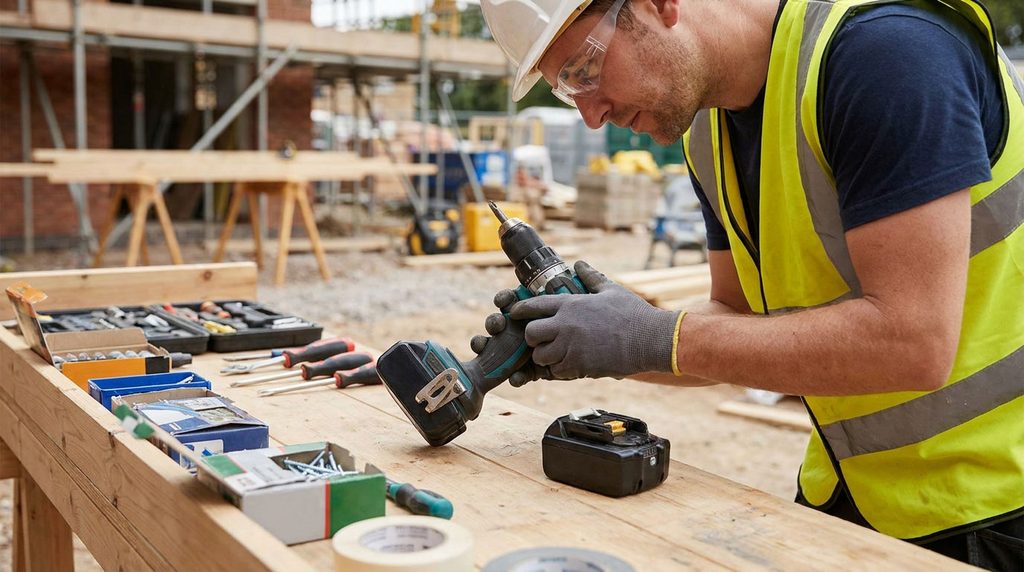
Follow the manufacturer’s pre-use inspection instructions. Review guards, handles, switches, cables, plugs, and battery condition as applicable. Watch for cracked housings, damaged insulation, loose components, or missing protective parts. Confirm that equipment suits the task and operating environment.
Remove defective tools from use and follow the site’s reporting and isolation procedures. Do not make improvised repairs or bypass guards. Electrical protection and any required testing should be handled under the site’s procedures by personnel with the appropriate training and qualifications.
Do not assume a cordless tool is automatically ready for use. Review its battery, charger compatibility, and storage condition according to the manufacturer. Keep inspection tasks separate from operation, and prevent accidental startup. When a fault is unclear, stop using the item and ask the responsible supervisor or maintenance specialist to assess it.
Confirm Fall Protection and Required Specialist Inspections
Identify exposed edges, floor openings, ladder access, scaffold platforms, and excavation areas before assigning work. Confirm that the required protective systems are installed and suitable for the activity. A warning sign alone does not replace a required physical safeguard.
OSHA’s scaffold standard requires a competent person to inspect scaffolds for visible defects before each shift and after events that could affect structural integrity.
Under OSHA’s excavation requirements, competent-person inspections are required daily when employee exposure is reasonably anticipated, before work, as needed during the shift, and after rainstorms or other hazard-increasing events.
Pause Affected Work When Protection Is Missing
Keep workers out of the affected area until the responsible person verifies suitable precautions. A general walk-through cannot replace these task-specific inspections or authorize an untrained worker to approve scaffolds, excavations, or fall-protection systems.
Check Protective Equipment for Condition and Fit
Match protective equipment to identified hazards. Review head, eye, hand, foot, hearing, and other protection required for the task. Look for damage, worn components, and fit problems before work begins. OSHA’s construction PPE standard requires employers to select equipment that properly fits each affected employee.
Keep PPE within a broader prevention strategy. The NIOSH hierarchy of controls prioritizes eliminating hazards, safer substitutes, and engineering controls ahead of relying on procedures and protective gear alone.
Check Heat, Weather, and Recovery Areas
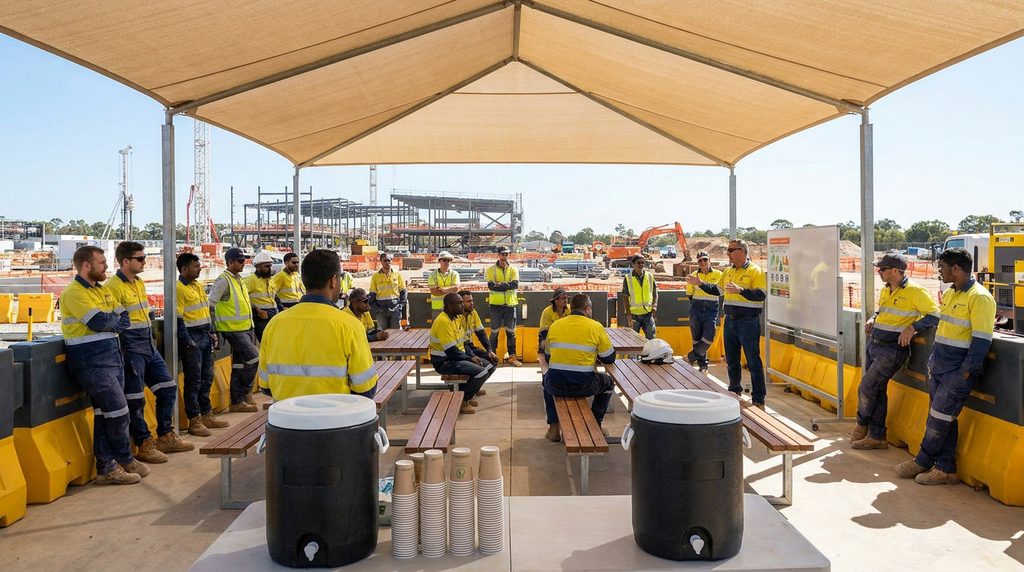
Review heat, humidity, direct sunlight, workload, and protective clothing together. A weather forecast does not fully describe conditions beside hot equipment or on exposed surfaces. Reassess conditions during the shift rather than relying only on the morning temperature.
Confirm that drinking water, suitable rest arrangements, and a cool recovery location are available. OSHA’s water, rest, and shade guidance explains these preventive measures. Include a gradual heat-acclimatization plan for new or returning workers, appropriate supervision, and clear instructions for reporting symptoms.
Identify who will monitor changing weather and communicate any decision to pause or reschedule work. Heat is not the only concern: rain, lightning, strong winds, and reduced visibility can also change the suitability of planned activities. Follow the site’s weather-response procedures and equipment limits, and revisit the task plan whenever conditions deteriorate.
Brief the Crew and Confirm Emergency Readiness
Before work starts, discuss the most important hazards and the controls that address them. Explain changes to access routes, exclusion zones, equipment movement, and task sequencing. Invite questions, especially from workers unfamiliar with the site.
Confirm how workers will raise an alarm, contact emergency services, locate first-aid resources, and reach the assembly area. Make sure responders can access the worksite. Review any task-specific rescue arrangements before hazardous activities begin, rather than improvising after an incident.
Record Findings, Correct Problems, and Recheck
Assign Responsibility for Each Unresolved Hazard
Record the location, hazard, immediate protection, responsible person, and required follow-up. Paper and digital checklists can both support this process. Neither proves that a problem has been fixed.
Verify the Correction Before Closing the Item
For example, a damaged extension cord should remain out of service while replacement is arranged. Close the item only after an appropriate person confirms the corrective action. OSHA’s hazard-control guidance emphasizes checking that controls are implemented and effective.
Carry unresolved findings into the next handover so the incoming crew does not mistake an unfinished repair for a completed one.
Repeat relevant checks when work methods, weather, personnel, or site conditions change. Daily jobsite safety checks are most useful when they lead to decisions, corrections, and continuing communication—not just a signed form.
Continue exploring our jobsite safety articles to strengthen your understanding of workplace hazards and protective measures.
This article provides general educational information for U.S. worksites. Follow applicable federal and state requirements, manufacturer instructions, and site-specific procedures. It does not replace professional assessment or required training.